Friday, August 31, 2012

A Post for Bedtime

Here's one of my favorite poems brought to you by poets.org . . . .


By Henry Wadsworth Longfellow


The day is done, and the darkness
   Falls from the wings of Night,
As a feather is wafted downward
   From an eagle in his flight.

I see the lights of the village
   Gleam through the rain and the mist,
And a feeling of sadness comes o'er me,
   That my soul cannot resist:
   
A feeling of sadness and longing,
   That is not akin to pain,
And resembles sorrow only
   As the mist resembles the rain.
   
Come, read to me some poem,
   Some simple and heartfelt lay,
That shall soothe this restless feeling,
   And banish the thoughts of day.

Not from the grand old masters,
   Not from the bards sublime,
Whose distant footsteps echo
   Through the corridors of Time. 

For, like strains of martial music,
   Their mighty thoughts suggest
Life's endless toil and endeavor;
   And to-night I long for rest.
   
Read from some humbler poet,
   Whose songs gushed from his heart,
As showers from the clouds of summer,
   Or tears from the eyelids start;

Who, through long days of labor,
   And nights devoid of ease,
Still heard in his soul the music
   Of wonderful melodies.

Such songs have power to quiet
   The restless pulse of care,
And come like the benediction
   That follows after prayer.

Then read from the treasured volume
   The poem of thy choice,
And lend to the rhyme of the poet
   The beauty of thy voice.

And the night shall be filled with music
   And the cares that infest the day,
Shall fold their tents, like the Arabs,
   And as silently steal away.

Thursday, August 30, 2012

Why Kids May Like Danny Instead of Fred

             My younger brother occasionally likes to watch PBS TV shows online, and he occasionally does so while I happen to be in the same room. That's where I learned about this guy:

Meet Daniel Tiger, ain't he cute?

            To be released on PBS this September, Daniel Tiger is the new star of the upcoming show Daniel Tiger's Neighborhood. For anyone curious, this little guy opens the show by putting on his shoes and singing about how it's a beautiful day in the neighborhood. Sound familiar? If it doesn't, maybe this will refresh your memory.


          That's right, Daniel Tiger's Neighborhood is going to replace Mr. Rogers' Neighborhood this Autumn. As the new Mr. Rogers, Danny gets the theme music, the trolley, and an assortment of other things from the first show.

          I remember enjoying a couple episodes of Mr. Rogers when I was young, but I was never really a fan. So instead of a rant of how TV and PBS aren't like they were back in my day, this post will be identifying some possible cultural shifts that might explain why PBS would feel that Danny needed to replace Fred.


Wednesday, August 29, 2012

A Post On Blessings

            Today's new word . . . .

             Benison (pronounced ben - uh - son)


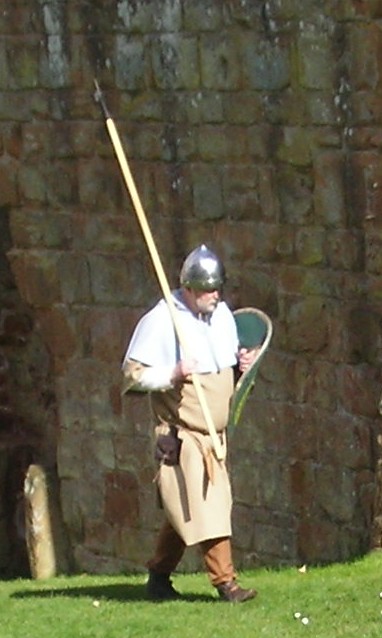
                Benison is defined as a blessing or a benediction by the dictionary. It stuck out to me because it sounds so much like the word venison, which would make benison easily incorporable in a story set in the Middle Ages.


               I can always remember the definition of the word venison, since Robin Hood offers it to the Friar Tuck shown above in my favorite version of Robin Hood. Perhaps that's why it sounds like it belongs in the time.

Tuesday, August 28, 2012

Whining On the Inside, That's Better, Right?

             Last week, I posted some thoughts about Philippians 2:14-15. I wanted to add a few thoughts on top of that.

            I looked up the word complaining that's used in verse 14 in a Bible Lexicon and noted that the Greek word (goggusmos) is the same word used to indicate a "secret displeasure not openly avowed." So verse 14 reads something like this:

             Everyone be the cause of everything without any secret displeasure not openly avowed and displeasure and arguing. (Interlinear Bible)

            It's important to note that this does not take away from the verse from our English understanding of it. The word complaining as used in English means "to express grief, pain, or discontent" (according to Merriam-Webster) and the Greek goggusmos also means muttering or mutter, which are synonyms with complain. This extra meaning we get from goggusmos simply adds to the command.

           To provide a better illustration, imagine you're asked to walk the dog in the rain. You get up and neither argue nor say anything about it, but simply take the dog into the downpour. While on the walk, however, you think about how awful the rain is, how inconvenient this dog walk is, and how you'd rather be doing anything else. This is still going against this verse, because you are only expressing your displeasure secretly and not avowing it openly.

          Remember that God cares more about what's in your heart than what you display on the outside (1 Samuel 16:7), so complaining on the inside is just the same to God as complaining outwardly. I don't say this all to condemn or make any of my readers feel bad, I just want you to be aware of what the Bible says so that you can further please God.

         That's the most important thing, right?

Monday, August 27, 2012

What Good Children Do

The Reading (Titus 3:1-2):


              "Remind them to be subject to rulers, to authorities, to be obedient, to be ready for every good deedto malign no one, to be peaceable, gentle, showing every consideration for all men" (New American Standard Version)

             "Remind them to submit to rulers and authorities. They should be obedient and ready to do every good thing. They shouldn't speak disrespectfully about anyone, but they should be peaceful, kind, and show complete courtesy toward everyone"  (Common English Bible)

             "Remind them to be submissive to rulers and authorities, to be obedient, to be ready for every good work, to speak evil of no one, to avoid quarreling, to be gentle, and to show perfect courtesy toward all people" (English Standard Version)

             "Put them in mind to be subject to principalities and powers, to obey magistrates , to be ready to every good work, To speak evil of no man, to be no brawlers, but gentle, shewing all meekness unto all men" (King James Version


Sunday, August 26, 2012

Martial Arts: Elementary, My Dear Readers

              One of the best things about a classic novel is that it isn't locked in one time frame. While the Percy Jackson and the Olympians series might have been a New York Times Bestselling series, it probably won't become a classic because it is too heavily rooted in the culture of contemporary America. Pride and Prejudice, while also rooted in the culture of Austen's day, is not rooted to the point where readers of today cannot identify with it. The only difficulty with the classics that I've found is that sometimes an author uses a well-known phrase or expression of his time that someone might not know a hundred years from now.

            Something like that happened when I first read Sir Arthur Conan Doyle's "The Adventure of the Empty House" (a Sherlock Holmes tale, for those who don't know). Holmes mentions to Watson that he has some general knowledge of baritsu, or Japanese wrestling. When I read this, I assumed that most people in late nineteenth century England would know what baritsu was, but for me, it was just another amazing trick the Great Detective had up his sleeve. I did some research and discovered that in actuality, people in Doyle's time also weren't sure of what it meant.

            This video accurately describes the history and definition of baritsu better than I could (I claim no credit for the creation of this video)


Saturday, August 25, 2012

A Great Debt


"For, until men feel that they owe everything to God, that they are cherished by his paternal care, and that he is the author of all their blessings, so that nought is to be looked for away from him, they will never submit to him in voluntary obedience; nay, unless they place their entire happiness in him, they will never yield up their whole selves to him in truth and sincerity" - John Calvin

Amen.

Friday, August 24, 2012

Didn't I See That Somewhere Already?

            Max Beerbohm - "All fantasy should have a solid base in reality."

            While I think this is true, I also think that it's hard to create any fantasy element without borrowing from what God has already created, therefore rooting it in reality. For example. . . .


          Equals. . . .


          Plus. . . .


          Am I correct?

Thursday, August 23, 2012

Is This Guy Trying to Be Funny?

             In addition to there not being one way to write the perfect story, there is no way to make the perfect joke, pun, or humorous saying. The difficulty is that, like with the perfect story,  everyone has different tastes in what they call funny, different backgrounds that inform said tastes, and different situations that influence their feelings (in the days after the recent shootings, not many people were laughing at gun jokes). Additionally, it's nearly impossible for one person to determine if they are funny or not, since what makes them laugh might make another person with similar humor tastes not laugh.

            As I was pondering the problem of puns, I thought up a couple ways to make a joke, all of which can be incorporated into some form of writing.

Make a Connection Between Two Unsimilar Things (Appeal to the Unexpected)


              Who would expect a guy with facial hair to sing and dance like Miley Cyrus?

Make a Connection That Is Accurate Between Two Things (Appeal to the Expected)


            This trick is a little harder, since the audience might guess the punchline from the situation. In the above video, after the villain kills that guy with the quill, the audience might expect the line about the pen (although, Joker is so creepy in appearance in this video that humor might be hard anyway). Still, that's how it's done.

Make a Point and Connect Back to It (Appeal to the Long Memory)


            I don't need to expound upon this one, since it is possible to determine if you are hilarious or not (get it? It's that simple).

           Do you have any other suggestions of how to be funny?

Tuesday, August 21, 2012

How to Make a Marlowe in 12 Easy Lessons (Part 2)

            Here are the remaining (abridged) lessons from Raymond Chandler, not all of which I agree with. (personal comments included in parantheses, and the full version of these lessons can be found in this book)


Addenda
  1.     The perfect detective story cannot be written.
  2.       The most effective way to conceal a simple mystery is behind another mystery. This is literary legerdemain. You do not fool the reader by hiding clues but by making him solve the wrong problem.
  3.       It has been said that “nobody cares about the corpse.” This is bunk. It is throwing away a valuable element. It is like saying the murder of your aunt means no more to you than the murder of an unknown man in an unknown part of a city you never visited.
  4.       Flip dialogue is not wit.
  5.       A mystery serial does not make a good mystery novel.
  6.       Love interest nearly always weakens a mystery story because it creates a type of suspense that is antagonistic and not complementary to the detective’s struggle to solve the problem. The kind of love interest that works is the one that complicates the problem by adding to the detective’s troubles but which at the same time you instinctively feel will not survive the story. A really good detective never gets married. He would lose his detachment, and this detachment is part of his charm.
  7.        The fact that love interest is played up in the big magazines and on the screen doesn’t make it artistic. Women are supposed to be the targets of magazine fiction and movies (says who?). The magazines are not interested in mystery writing as an art. They are not interested in any kind of writing as an art (again, says who?).
  8.       The hero of the mystery story is the detective. Everything hangs on his personality. If he hasn’t one, you have very little. And you have very few really good mystery stories. Naturally.
  9.       The criminal cannot be the detective. This is an old rule and has once in a while been violated successfully, but it is sound as it ever was. For this reason: the detective by tradition and definition is the seeker after truth. He can’t be that if he already knows the truth. There is an implied guarantee to the reader that the detective is on the level.
  10.      The same remark applies to the story where the first-person narrator is the criminal. Conceal nothing.
  11.      The murderer must not be a loony. The murderer is not a murderer unless he commits murder in the legal sense.
  12.      There is no real possibility of absolute perfection in writing a mystery story.
  13.      All fiction depends on some form of suspense.

Monday, August 20, 2012

25? Really?

           When I started this blog, I didn't think much would come of it. Most of what I post is, after all, common sense for writers, and other bloggers have done it better. What I didn't figure on was my liking this blogging game. There is something about learning something, applying it, and then teaching it that appeals to me. Despite my ideas of closing shop after post ten, I somehow produced twenty-five posts that I only seldom alter afterwards. Whether or not my readers agree with that decision is another story.

            I thought I'd do something off the beaten track to celebrate my twenty-fifth post in addition to redecorating the place (does anyone like the new look?). As I've seen other bloggers do something like this (by the way, does anybody know what tagging means?), I thought I'd throw out ten questions, answer them, and ask all my blogging friends to do the same. Lord willing, I'll do something similar when I hit post number 50, 75, 100, etc.

            This should be fun.


Sunday, August 19, 2012

But I Don't Wanna Post This

             The sermon at church today was about church unity from Philippians 2:14-15.

14 Do all things without grumbling or disputing ; 15 so that you will prove yourselves to be blameless and innocent, children of God above reproach in the midst of a crooked and perverse generation, among whom you appear as lights in the world (English Standard Version)               My pastor had several good points, and as I meditated on the text, I couldn't help but think of a few comments myself.               Do all things without grumbling or disputing                           Firstly, we should take note that we are to always do everything without grumbling or complaining, even after we've finished. Have you ever known anyone who cheerfully does a job only to gripe about it later? If so, did that person complain about the work, or worse, about the person who gave them the job? Even though the action has passed, the fact exists that said person is still complaining, grumbling, or causing disharmony. Don't think that an old act can be complained of. 

Saturday, August 18, 2012

Not a Lesson To Quickly Read Through

Split me infinitives! Not this lesson again!

          In a review on The Screwtape Letters, the reviewer said about the main character, though a demon, could "no more split an infinitive than do a good deed." If you're like me, still reading grammar books after graduating from high school, then a reminder is needed.

           What is a split infinitive?

            An infinitive is a verb in its most basic form. The verb to run is an infinitive, since it tells us nothing about the time of the action, who performed the action, or even where the action was performed.

            You can use an infinitive to make general statements (To live is the greatest adventure), to continue a previous point (as I just did), or as the second verb that shares a subject with a preceding verb (He wants [main verb] to use [infinitive] the garden hose).

Friday, August 17, 2012

Jimmy Cracked "Corn", But I Don't Care


             If you've read my recent character analysis post about James Bond, you might get the impression that I'm a Bond fan. My reply would be that I'd like to be a Bond fan--I could always use another book to read--but there is too much going on in the story that I'm uncomfortable engaging in. While there are several reasons why someone wouldn't pursue the Bond novels/movies, I wanted to think about one in particular.

            One thing that turns most prospective fans away is Bond's seemingly immoral opinion of violence. Most people cannot cheer for a hero who maintains a cool attitude while he shoots, strangles, drowns, poisons, or bleeds his enemies to death. I've noticed, additionally, that not only does Bond not seem to care how he kills his opponent (in Goldfinger, he electrocutes an assailant with a charged bathtub just because the hit man was in it and 007 happened to have a plugged-in lamp handy), there are times when he actually seems to enjoy it.

           Surprisingly, this is not the reason why I wouldn't associate with Bond, James Bond.

Thursday, August 16, 2012

How to Make a Marlowe in 12 Easy Lessons (Part 1)

             If you've read more than a few mystery novels in he past, you've probably heard how readers tend to divide the genre into three sections: the cozy, the hard-boiled, and the police procedural. Later on, Lord willing, I plan to post in detail about the elements of these sections. For now, I'd like to share 12 (abridged and edited) rules about writing a mystery story from pulp mystery writer Raymond Chandler (all of which can be found in full form in this book).

For those who don't know, Humphrey Bogart became the face of hard-boiled detectives after his portrayal as Sam Spade and Philip Marlowe, two of the more famous characters of the genre


Wednesday, August 15, 2012

Like the Guy Who Stands Outside the Portcullis

 Palisade (like palace-aid)


            The dictionary defines palisade as a wall of stakes, usually pointed, used for defense. Take note, fellow writer, how this word both sounds like the words palace and aid, (as shown in the pronunciation guide above) and how it is involved with defense. The readers who enjoy fantasy or Middle Age era novels can tell you that while the castle's defense might include drawbridges, nothing is a replacement for the sentry guard, who aids the palace.

Palace aid

Palisade


            Aren't words wonderful?

Tuesday, August 14, 2012

Dirty or Formerly Dirty

              Currently, this is one of my favorite passages of the New Testament. Probably because it's so powerful, and still applicable; common of the Christian Bible overall.

Source: Google Image Search

The Text: Acts 10:15


"And a voice [came] unto him again the second time, What God hath cleansed, make not thou common" (American Standard Version)

"And the voice came to him again a second time, "What God has made clean, do not call common" (English Standard Version)

"The voice spoke a second time, "Never consider unclean what God has made pure" (Common English Bible)

The Context: Acts 10:9 - 15 (New American Standard)


          This is slightly new, but I thought it wouldn't be fair to give the reasoning on the text without some context first.

9 On the next day, as they were on their way and approaching the city, Peter went up on the housetop about the sixth hour to pray.
10 But he became hungry and was desiring to eat ; but while they were making preparations, he fell into a trance ; 11 and he saw the sky opened up, and an object like a great sheet coming down, lowered by four corners to the ground, 12 and there were in it all kinds of four-footed animals and crawling creatures of the earth and birds of the air. 13 A voice came to him, "Get up, Peter, kill and eat !" 14 But Peter said, "By no means, Lord, for I have never eaten anything unholy and unclean." 15 Again a voice came to him a second time, "What God has cleansed, no longer consider unholy."


Thursday, August 9, 2012

The Smart, Quiet Guy

         Robert W. Service - "Be sure your wisest words are those you do not say."


          If this sounds like a familiar concept, Solomon had some similar thoughts:

          "When words are many, transgression is not lacking, but whoever restrains his lips is prudent" (Proverbs 10:19).

          "A prudent man conceals knowledge, but the heart of fools proclaims folly" (Proverbs 12:23).

          "Whoever guards his mouth preserves his life; he who opens wide his lips comes to ruin" (Proverbs 13:3)

          "Whoever restrains his words has knowledge, and he who has a cool spirit is a man of understanding. Even a fool who keeps silent is considered wise; when he closes his lips, he is deemed intelligent" (Proverbs 17: 27 - 28)

         Food for thought.

Wednesday, August 8, 2012

It's True Because I'm the Expert

             Today's new word is . . . .


Usageaster (pronounced you - sig - as - ter)

            We have a few different definitions for the word. According to Dictionary.com, the word refers to a person who assumes that they know enough about language usage to be a professional. I suppose some synonyms for usageaster might be: stickler, word-fusser, grammar-freak, etc.

Examples of the Word:


         Claiming to be an English usage authority, the usageaster proceeded to correct my paper.

          I hardly know anything about grammar. I'm no usageaster.

           A word of warning, dear readers. I checked some other dictionaries, and this word was not present in any of them (look here for the dictionaries that do). This could mean that it is an old word, or it could mean that it is a word that has fallen out of common usage. We writers should remember when choosing the perfect word to choose one that our audiences either know, or can easily access. Nothing trips up a reader more than stumbling across a word that he can't define in context, but don't add to the trouble by using a word the dictionary can't help him with.

Tuesday, August 7, 2012

The Ultimate Fight

          I wrote this in my spare time. It is an Italian sonnet.

          For the not-so-smooth-with-poetry people, a sonnet is defined by Merriam-Webster as "a fixed verse form . . . consisting of 14 lines that are typically 5-foot iambics rhyming according to a prescribed scheme." In other words, fourteen lines of writing with five beats per line.

        
    I hook and cross and kick high from the side,
    He knocks my body down with only pride.
    I trip him, strike him and dodge him, alack,
    He cleverly knows where to strike me back.
5              Because I am too proud, I always try
                To best this foe, for else I know I’ll die.
                Can you know this creature? His bite and sting
                That keeps me hurt, and from my own dear king?
                I am not just a failing man, a door
10           That swings like lazy men sleep, like a floor.
                Who is my foe? Why fight? And his answer
                Did shake me, making my mind a dancer.
                “Until you know yourself, I have no name,
                And when you know the truth, He’ll help you tame.”

Monday, August 6, 2012

The Two Angers

        For my first post under Interesting Alternatives to Prose, I thought it'd be nice to begin with a poem I've written. Remember, I believe that a writer's growth comes through critique as well as through practice, so feel free to drop a comment if my poetry doesn't dazzle you.

       Here goes . . . .


An anger that kills and an anger that feeds,

One used by good men and one used by the rest,

By one anger a house was cleaned of evil seeds

And by the second, a good man failed a great test.

One anger that glared, bit, and snarled for its way,

One anger that enforced and did not insist,

One anger that cared not for who would go or stay

And one anger that knew right, following God’s list.

Two angers, two births, two uses, and parents

And yet only one anger will lead to our inheritance.

Sunday, August 5, 2012

At Least We Have Homeschooling

         I originally intended for there to only be seven labels I'd be writing under, but I've decided to add two more.

History For the Wondering Wordsmith - It's wonderful for writers to know how to craft their prose, but it's useless if they don't have anything to write about. I'd like to talk in these posts about history facts that appeal to me in hopes that it will spark you all to research and come up with historical interests of your own.

Interesting Alternatives to Fiction - In Craft Talk, I talk about the formation of writing both prose and poetry. In Fiction Reading, Writing, and Thinking, I apply the lessons from Craft Talk to fiction writing. In Interesting Alternatives to Fiction, I attempt my hand at writing everything but fiction.


       Let's start with the former. . . .

You Think You Have It Bad?

       When something isn't going exactly as one wants it too, how many times have you told him something to the effect of; "You think you've got it bad? A hundred years ago they didn't even have (whatever it was)."

       I'm reading Dickens' Fur Coat and Charlotte's Unanswered Letters, and reading some of the things Charles Dickens did for research made me feel like using the aforementioned sentence.

       By January of 1838, Charles Dickens had created the bestselling Pickwick Papers, was editing Bently's Miscellany, and working on novels in his spare time. He had achieved fame like few authors had at this time. But the project he was working on at this time was somewhat different than his previous works.
       Dickens had always been inspired by horror stories he had heard about boarding schools when he was growing up, and he decided to investigate one to get an idea of how they actually operated. So that January, Dickens and a man named Phiz--the illustrator who worked with the great writer--began to investigate the schools for boys in the Glasgow area, which were reported to be places where parents sent the children they didn't want around the house (I don't know why, but reading this put the Pleasure Island scene from Disney's Pinocchio in my head). The only reason the headmasters allowed their investigations, particularly one William Shaw who had apparently been brought to court for the poor conditions of his school, was that the two were disguised as representatives of a family wishing to send their son to the school. Among the more interesting horror stories that students gave Dickens was the tale that:

      teachers, who to parents were all benevolence when they picked up the boys, seized the students' clothes once they arrived at school . . . gave them wooden clogs for shoes, and fed them black bread, water, and milk with only a daily ounce of often putrid meat . . . a boy who ran away was stripped naked, tied to the door, and brutally flogged in front of a whole dormitory, the process then being repeated in another dorm. (Dickens' Fur Coat and Charlotte's Unanswered Letters, pg. 27)

      Additionally, research taken at William Shaw's school turned up more interesting results:

     Dickens and Phis visited a churchyard near Shaw's school where some twenty-nine boys who had died at the local boarding schools between 1810 and 1834 had been buried. A laconic entry in the Burial Register concerning the death of an eight-year-old--'supposed a native of Newcastle'--testified not atypically to the evident lack of family interest in the fate of one small victim. (Dickens' Fur Coat and Charlotte's Unanswered Letters, pg. 27)

      If that wasn't bad enough, the lawyer who had provided the two with a letter of introduction reportedly told them (in the privacy of their inn room, of course):

     Dinnot let the weedur send her lattle boy to yan o' our school measthers, while ther's a harse to hoold in a' Lunnun, or a goother to lie asleep in . . . Ar wouldn't mak' ill words amang my neeburs, and ar speak tiv'ee, for weedur's sak', to keep the lattle boy from a' sike scondrels! (Dickens' Fur Coat and Charlotte's Unanswered Letters, pg. 29)

       Doesn't this make homeschooling, even modern public schooling, sound more agreeable?

Saturday, August 4, 2012

Why People Might Like Jimmy


            In my original structure, I said this about my Fiction Reading, Writing, and Thinking posts:

When I have the time, I will combine all of the above labels in a post that analyzes a piece of text discussing its construction, audience, and biblical merits.

            I’m broadening these posts slightly. In addition to analyzing fiction text, I’ll also analyze movies, or possibly make an attempt at writing what is known in academia as creative writing. That is, flash fiction, a short story, or (possibly) a blog novel. As always, feel free to drop a comment with a suggestion of how I’m doing.
            For my first Fiction Reading Writing, and Thinking piece, I’d like to do a character analysis on a person almost everyone in America is familiar with, or at least has heard about.

Some Thoughts About James Bond

Source: Google Images
        If you are a part of one quarter of the contemporary world's population, you've probably either seen or heard of some James Bond movie. Particularly in the United States, the combined box office returns for all the Bond films amounted to around five billion dollars, making it slightly less successful than the Harry Potter series. The James Bond franchise will be enjoying its fiftieth anniversary this year with its sixth James Bond (Daniel Craig). For those interested, the other Bond actors were Sean Connory, George Lazenby, Roger Moore, Timothy Dalton, and Pierce Brosnan.

        I, having a fairly imaginative childhood, was no exception to the espionage craze. I wanted to be a secret agent when I was eight, I played spy when I was ten, and I saw Goldfinger when I was twelve years old (for those who may not know, Goldfinger has been described as actor Sean Connory's most popular Bond portrayal). I enjoyed the movie (though I was scared that Oddjob would pop out of my closet at any time), though I don't recall ever asking myself what it was about Bond that I found so appealing.

        When my older brother let me watch Daniel Craig in Casino Royale (covering up the less than flattering scenes, of course), at the age of fifteen, I finally began wondering what it is about Bond that I liked so much. At the time, I thought my fascination came from the excitement and action that ran rampant around Montenegro.

         Now that I'm in college and have taken some classes on how to spend your evenings rereading and making strange connections with novels and poems (also known as Literary Analysis), I took another look at the ever popular British spy in an attempt to find out what it was about him that so many people found appealing. After all, when you get down to it, much of Bond's work involves his use of his "license to kill," and modern audiences seem to have a growing displeasure watching death on the screen.

        So what makes Bond different than your average government killer? I've identified five possible traits that would connect him with modern audiences.

His Dedication to Duty


        Due to Bond's shadier side, I have tried to limit my knowledge of the spy. However, one trait I noticed in the movies I saw was that if his collar bone was broken, he was removed from the mission, or reassigned, he'd still do what he could to finish the mission. To Bond, the mission is his job, and nothing will stop him from getting it done.

His Self-Preservation


       In Goldfinger, there is this scene where an assassin sneaks up on James from behind with a knife poised to kill. Bond only survives because he sees the killer's reflection in the eyes of the girl he is kissing and is able to take him out. Even though Bond places the priority on the mission, he makes sure that his safety is in close pursuit. Whether keeping himself alive and well for the next mission means kicking the doctor off a cliff or hiding behind a moving rack of explosives, Bond knows precisely what to do to avoid extermination.

        As a side note, since watching Casino Royale, I'm beginning to think this trait is changing. There is a scene where the evil terrorist banker poisons Bond, who stumbles dying into his car to admit the medicine needed to save himself. He collapses before he can administer it, but the treasury representative revives him with it, and James does not seem to mind that a girl saved him. This could possibly reflect the cultural shift away from the classical hero saves the girl theme, but as long as Bond dies another day, everything is okay.

His Amazing Control of the Situation


        Granted, in many films Bond is captured or betrayed. However, one of the things I noticed about Bond is that you can always depend on him to get through a situation without losing his head. If I didn't know any better, I'd think he had the whole situation under his grip. For example, even after Goldfinger had Bond in prison, his calculating mind was at work formulating an escape. As is usually the case, it worked brilliantly. 

       Another trait that follows this well is Bond's amazing ability to get the situation back into his hands after losing it. In the Casino Royale construction yard chase scene, he demonstrates this by coming up with sixteen different ways of chasing the athletic bomb-maker who has the obvious head start.

His Quick Decisions


       Although Bond kills remorselessly, I think it's enviable how once he decides to act, he'll act without hesitating. Do you remember a time when you said or did something, only to regret doing it later? Bond never seems to have this issue, because he knows that whatever it was he did, it was either the right choice, or something that he should and can fix. In the poker scene in Casino Royale, despite losing and possibly financing terrorism, Bond quickly decides to take action. Granted, it was a better decision to help the CIA agent, but he still rose to the occasion to meet the banker for a second round. Espionage fans all around the US admire the man who meets his failures instead of moping about them.

His Wit


        James Bond is known for his confidence, his way with women, and his talent for turning a phrase. In particular, Bond is known for the somewhat coincidental one-liners he give upon killing an assassin. For example, in Dr. No, upon knocking a car full of killers off the side of a cliff, Bond remarks to a passerby; "I think they were on their way to a funeral." Like the hard-boiled detectives, no one alive will ever catch Bond speechless, nor will Bond ever find himself at a loss for conversation topics. At some point or another, most of us normal people will find ourselves in that social situation where an awkward pause hovers over the conversation and everyone involved will wonder who's going to talk next. I don't believe Bond will ever have this problem.


       In closing, Bond has all the makings of a top-notch secret agent, yet a particular human side as well. He has motivations (completing the mission), fears (his life), and desires to be recognized for what he knows (probably why such a cold man would be so witty). Perhaps these things make him so identifiable with our contemporary audiences.


      If not, then this is why . . .


       Even if you've no idea who James Bond is, you've probably heard this line before.


*Inspiration and some source work from this article. Parental approval may be required.